Year-end Recap: July to December

The much-anticipated return of Patrick Chan was the story in Canadian skating as the 2014-15 ISU Grand Prix season kicked off in October.

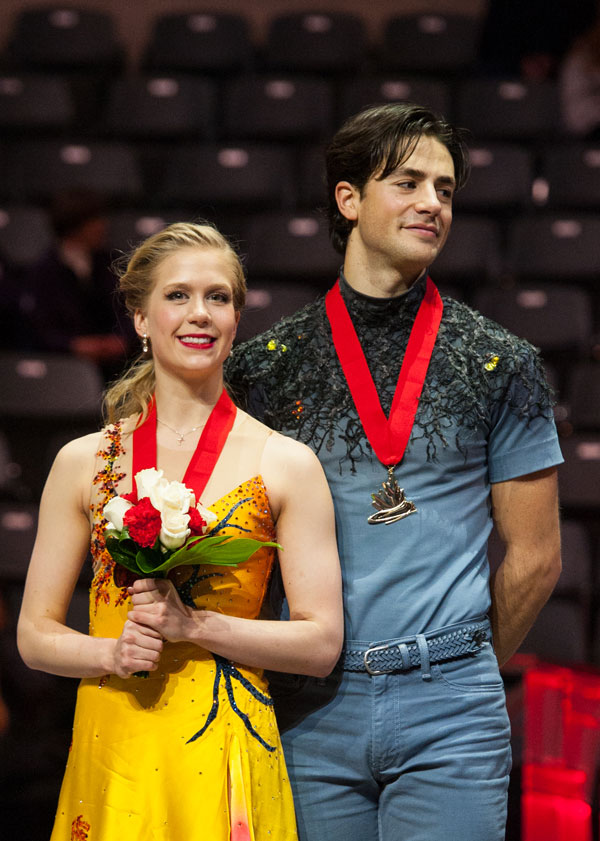
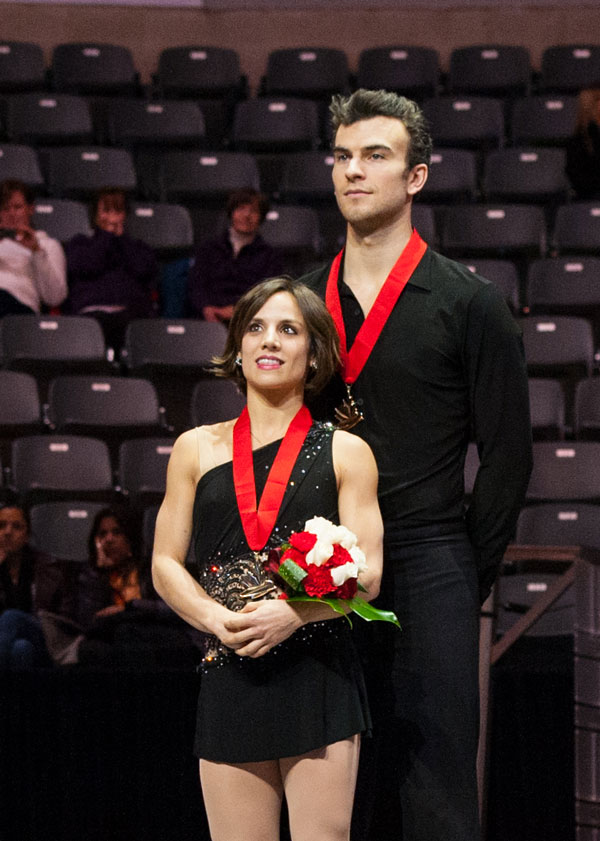
After a year off, three-time world champion Patrick Chan made his return to the competitive ranks at Skate Canada International, with a near-flawless free program to hold off reigning Olympic champion Yuzuru Hanyu for gold in Lethbridge, Alberta. World champions Meagan Duhamel and Eric Radford took the pair title, and Kaitlyn Weaver and Andrew Poje were golden in ice dance.

Ashley Wagner of the United States won the SCI ladies title.

The ISU Junior Grand Prix kicked off the 2015-16 skating season in August. Roman Sadovsky won the JGP Bratislava, and in September would add bronze at the JGP stop in Poland. Mackenzie Bent and Dmitre Razgulajevs snared silver in their international debut at the JGP Colorado Springs. Reigning Canadian junior men’s champion Nicolas Nadeau added a silver medal at the JGP Croatia.

At the senior level, Canada came away with two bronze medals at the U.S. International Figure Skating Classic, with the ice dance team of Élisabeth Paradis and François Xavier-Ouellette and the pair tandem of Kirsten Moore Towers and Michael Marinaro both placing third.

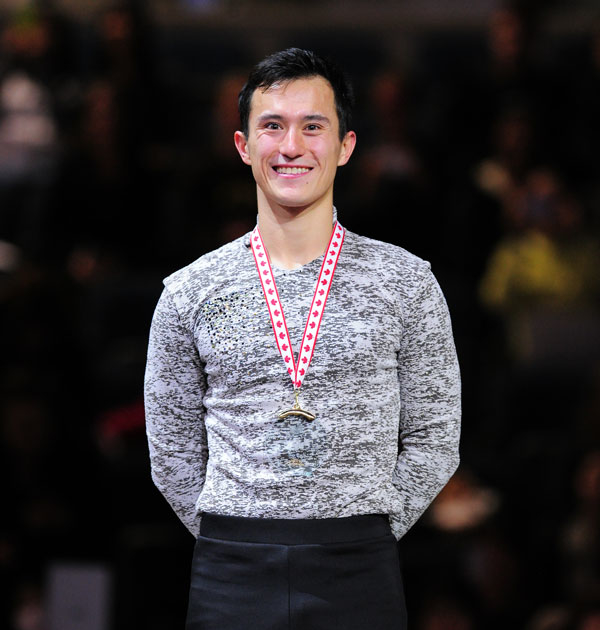
Elladj Baldé

Elladj Baldé

Kaetlyn Osmond

Kaetlyn Osmond

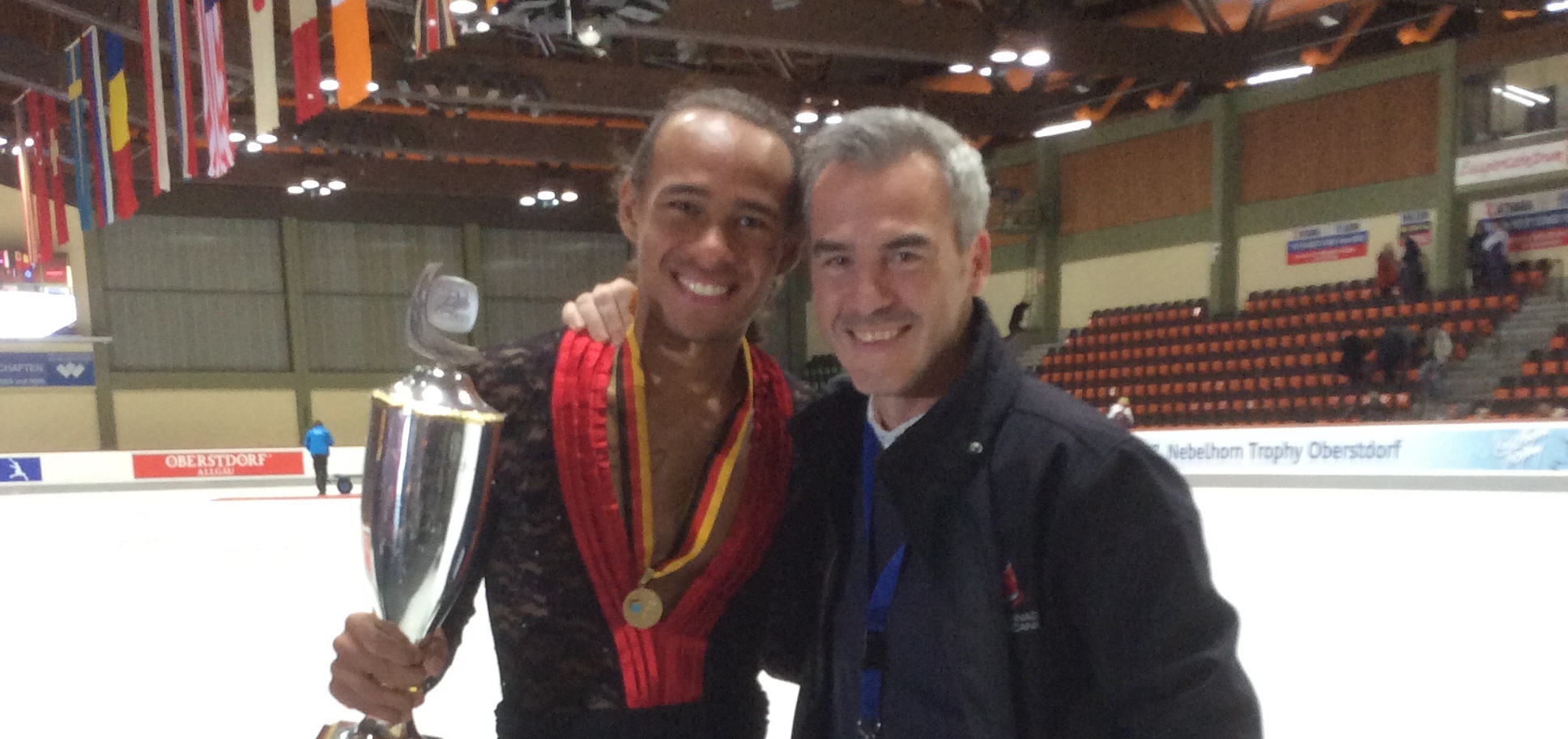
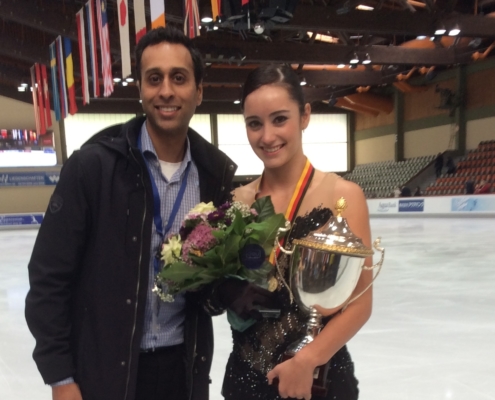
Canada enjoyed another medal haul at the Nebelhorn Trophy, with Elladj Baldé (men) and Kaetlyn Osmond (ladies) winning gold and Alexandra Paul and Mitchell Islam taking ice dance silver. Canada was golden in ice dance in back-to-back events, with Piper Gilles and Paul Poirier winning the Ondrej Nepela Trophy and Kaitlyn Weaver and Andrew Poje taking top honours at the Finlandia Trophy.

Skate Canada played host to Autumn Classic International in Barrie, Ont., as Duhamel and Radford took the pair title, as expected. In ice dance, Nicole Orford and Asher Hill won gold while fellow Canadians Andreanne Poulin and Marc-Andre Servant claimed silver.

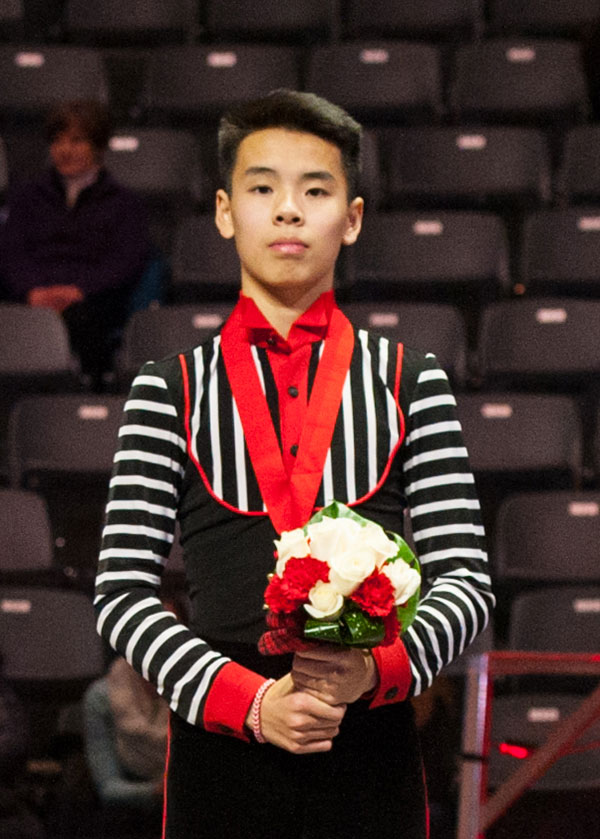
Nam Nguyen, the 2015 Canadian men’s champion, placed second to Yuzuru Hanyu. Elizabet Tursynbayeva of Kazakhstan won the ladies title, with Canadian Roxanne Rheault finishing fifth.

The ISU Grand Prix kicked off in October at Skate America, with Julianne Séguin and Charlie Bilodeau (pair) and Piper Gilles and Paul Poirier (ice dance) winning bronze.

As mentioned earlier, three gold medals by the host nation highlighted Skate Canada International in Lethbridge, Alberta in late October. Kirsten Moore Towers and Michael Marinaro added bronze in pair.

In November, Skate Canada announced its 2015 Hall of Fame inductees and several Skate Canada coaches were honoured with Petro Canada Coaching Awards later in the month.

Closing out 2015, Mississauga, Ont. was named host city for the 2016 Skate Canada International. Skaters from across the country competed at Skate Canada Challenge staged in Edmonton, Alb.

At the ISU Grand Prix Final, Kaitlyn Weaver and Andrew Poje repeated as ice dance champions, while world pair champions Meagan Duhamel and Eric Radford saw their two year undefeated run come to an end with a silver-medal performance in Barcelona.

With synchronized skating making its debut at the Grand Prix Final, defending world champion NEXXICE from Burlington, Ont. took bronze.The 2015-16 season continues with the 2016 Canadian Tire National Skating Championships, January 18 to 24 in Halifax, NS.

Year-end recap: Synchro

NEXXICE was on top of the world in 2015.

With the eyes of the synchro world on Hamilton, Ont., in April for the ISU World Synchronized Skating Championships, the Burlington, Ont. based powerhouse, competing just a few kilometres from their home base, thrilled a raucous hometown crowd with a nail-biting win for their first world title in six years.

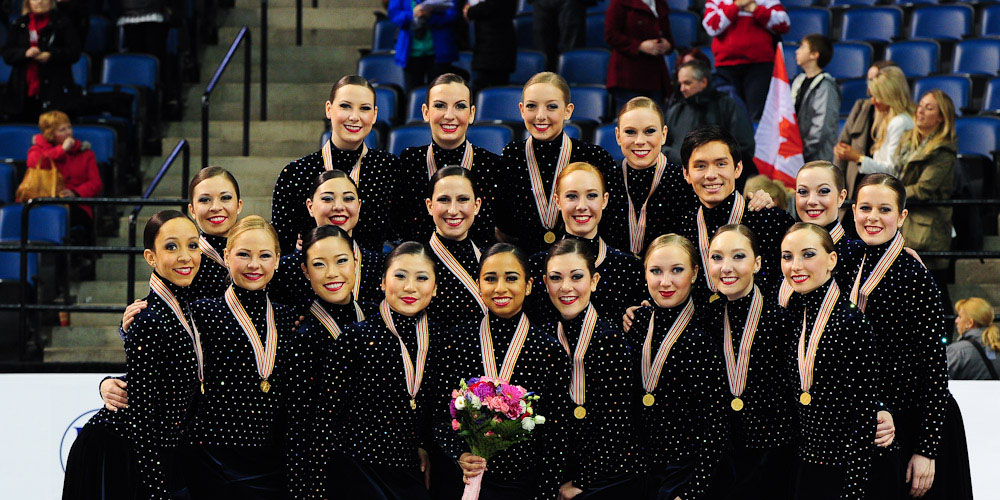
Nexxice on the podium.

NEXXICE

With an electric atmosphere inside the FirstOntario Centre, NEXXICE dethroned defending champion Marigold Ice Unity of Finland by a miniscule .67 of a point. Russia’s Team Paradise took bronze, that country’s first medal in the history of the world championships.

Quebec’s Les Suprêmes, Canadian silver medallists, finished sixth.

Les Supremes. 2015

Les Suprêmes

Earlier in the season, NEXXICE claimed the Trophy d’Ecosse in Scotland while Les Suprêmes won the Mozart Cup in Austria. Days later, NEXXICE Senior took gold at the Spring Cup in Italy, and the NEXXICE junior squad claimed silver at the same event.

Weeks before the World Championships, Canada’s best synchro teams met in Quebec City for the Skate Canada Synchronized Skating Championships. NEXXICE won their ninth consecutive senior crown and Les Suprêmes took the junior title before going on to win bronze at the ISU world junior championships.

Other teams to leave Quebec City with gold were NOVA (Open), Évolution (Intermediate) and Les Suprêmes (Novice).

Coming up tomorrow: Men’s, Women’s, Pair and Ice Dance (July to December)

Year-end Recap: Men’s, Women’s, Ice Dance and Pair (January – June)

As 2015 comes to a close, here is the first of a three-part look back at the year that was in Canadian skating:

As the calendar flipped to the New Year, Canada’s best skaters converged in Kingston, Ont. for the 101st edition of the Canadian Tire National Skating Championships.

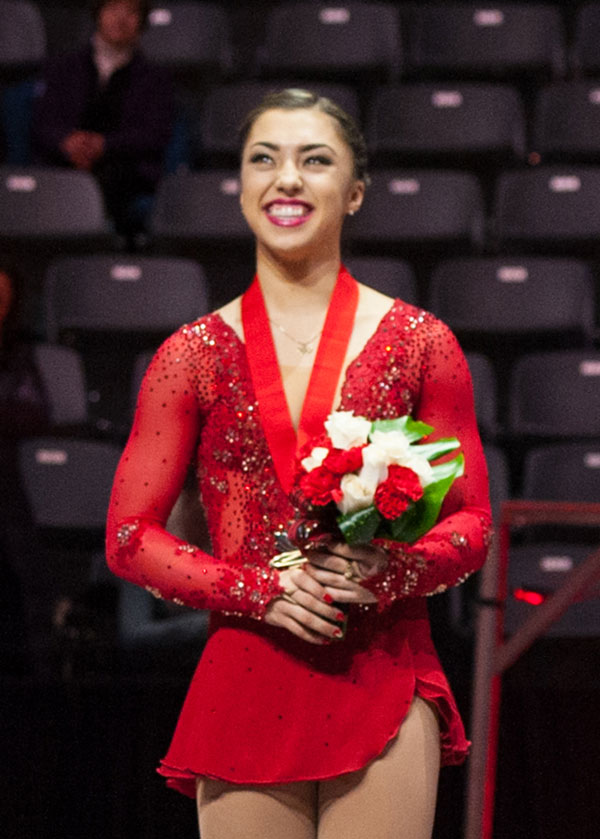
In what turned out to be a week of firsts, there were some new faces crowned senior national champions. Gabrielle Daleman claimed her first senior women’s crown, edging out Alaine Chartrand for gold. Nam Nguyen also took home his first senior men’s national title, while Kaitlyn Weaver and Andrew Poje won their first ice dance championship.

There were some familiar champions, as Meagan Duhamel and Eric Radford won gold for the fourth consecutive year, extending a perfect run that would continue into the 2015-16 season.

In the junior competition, Selena Zhao (women’s), Nicolas Nadeau (men’s), Brianna Delmaestro / Timothy Lum (ice dance) and Mary Orr / Phelan Simpson (pair) claimed junior national titles.

Sadness swept throughout the K-Rock Centre and across Canada on Saturday, January 24, during the senior free programs, when news broke that legendary Canadian figure skater Toller Cranston, a six-time Canadian champion, had passed away in Mexico at age 65.

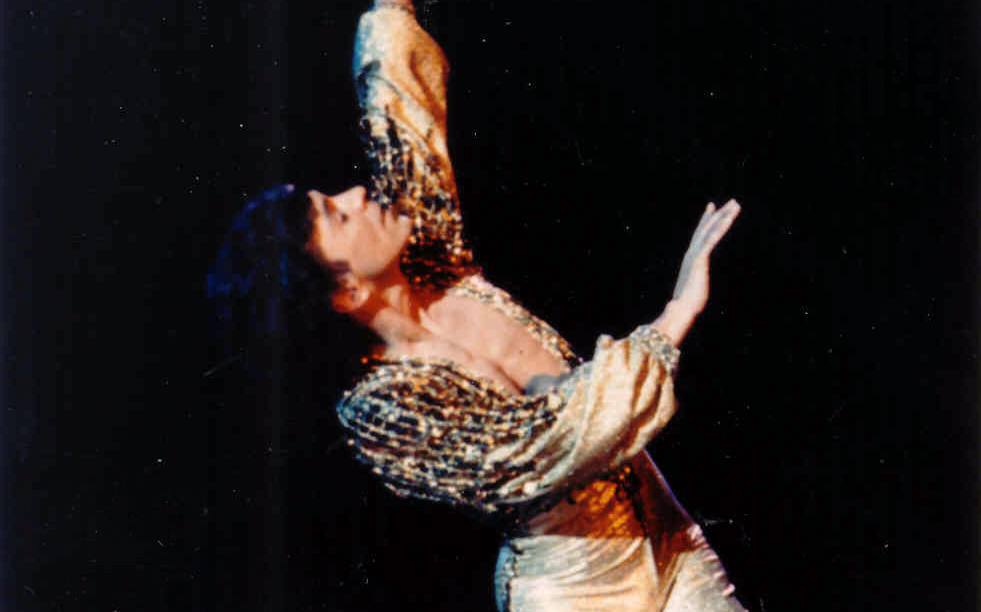
Toller Cranston

Toller Cranston

In February, it was double gold for Canada at the Four Continents Figure Skating Championships as Weaver and Poje took home ice dance gold before Duhamel and Radford won the pair title in the final tuneup before the world championships. Gabrielle Daleman had the best international showing of her career, finishing seventh.

The pair tandem of Julianne Seguin and Charlie Bilodeau left Tallinn, Estonia with a silver medal at the ISU World Junior Figure Skating Championships.

In late March, the skating world turned its attention to Shanghai for the 2015 ISU World Figure Skating Championships. Four-time Canadian pair champions Meagan Duhamel and Eric Radford capped off their perfect season by claiming their first world championship, while Kaitlyn Weaver and Andrew Poje secured ice dance bronze. Canadian men’s champion Nam Nguyen was fifth, while Gabrielle Daleman placed 21st.

Closing out the season, Canada ended up fourth at the World Team Trophy in Tokyo.

Hall of Fame Coach Sheldon Galbraith passed away April 14 and the following week the Skate Canada family suffered another tremendous loss with the sudden passing of Chief Operating Officer Bethany Tory.

In May, Canada returned home with 16 medals from the ISU Adult Figure Skating Competition in Oberstdorf, Germany.

Finally, on June 12th, three-time Canadian medallist and fan favourite Jeremy Ten, who placed second to Nguyen at the Canadian Tire National Skating Championships at the start of the year, announced his retirement from competitive skating.

Coming up tomorrow: Recapping the synchronized skating season

2015 Skate Canada Hall of Fame Inductees Announced

OTTAWA, ON: Skate Canada is pleased to induct six new members into the Skate Canada Hall of Fame.  This year Skate Canada celebrates the 25th anniversary of the Hall. The Hall of Fame was developed in 1990 to pay tribute to athletes, builders and professionals who have made a significant impact on Canadian figure skating.

The slate of 2015 will include ice dancers Marie-France Dubreuil and Patrice Lauzon, 2009 Synchronized Skating Team NEXXICE, and pair skaters Louise Bertram and Stewart Reburn in the athlete category. In the builder group, synchronized skating pioneer Cathy Dalton will be inducted. In the professional discipline, coach Richard Gauthier and choreographer Sarah Kawahara will be honoured.

Skate Canada is committed to celebrating the achievements of the skating community through the Hall of Fame, and through alumni programs which engage past skaters, officials, coaches and volunteers. Since the Hall’s inception, Skate Canada has inducted 104 members: 49 athletes, 32 builders and 23 professionals.

Marie-France Dubreuil, 41, and Patrice Lauzon, 39, both of Montreal, were a force on the international ice dance scene for nearly a decade; they enter the Hall in the athlete category. One of Canada’s most loved dance teams, they paired up in 1995. They went on to win the Canadian Championships five times (2000, 2004-2007) and won world silver medals in 2006 and 2007. They competed at the Olympic Winter Games in 2002 and 2006. Dubreuil and Lauzon retired in 2008 and began a successful coaching career in Montreal.

NEXXICE’s 2009 Synchronized Skating Team, from the Burlington Skating Centre will be the first synchronized skating team to enter the Skate Canada Hall of Fame; the entire 20 person team will enter in the athlete category. The 2009 NEXXICE team was the first ever Canadian team to win gold at the ISU World Synchronized Skating Championships, in Zagreb, Croatia. The team was comprised of: Jennifer Beauchamp (captain), Carla Coveart, Amy Cebulak, Tiffany Elliot, Ashley Greenhalgh, Morgan Harper, Cara Horan, Julia Horan, Taylor Kemp, Kristen Loritz, Nichole Manahan, Taryn Milne, Cara Moir, Sheri Moir, Michele Moore, Emily Penrose, Allison Proudfoot, Madeleine Wendland, Danyel Wright-Dykstra, and Lauren Zbucki.

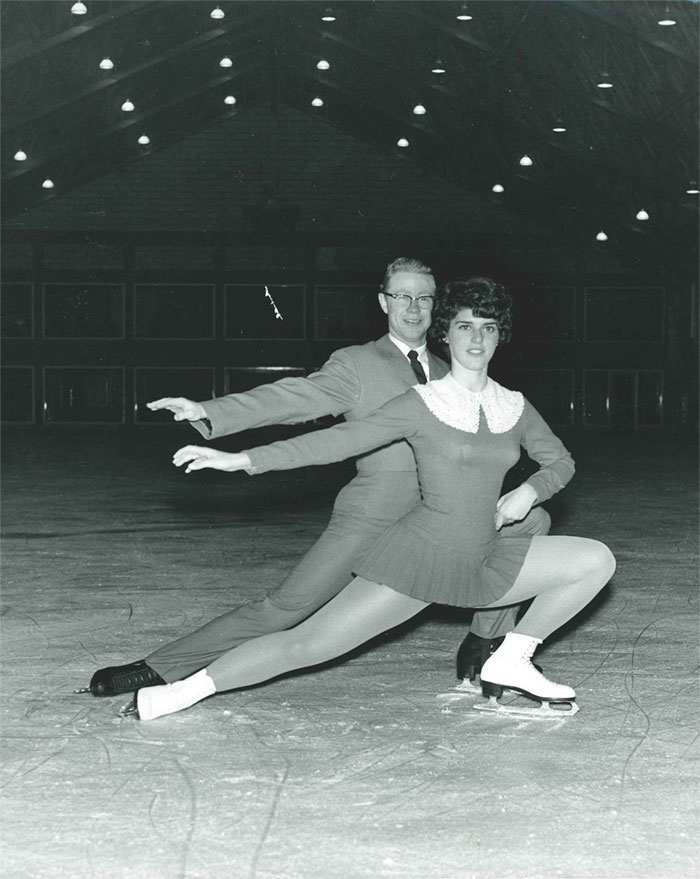
Louise Bertram and Stewart Reburn, both of Toronto, were the 1935 Canadian Pair Champions and will enter the Hall in the athlete category. Both are deceased; Bertram passed away in 1996 at age 88 and Reburn in 1976 at age 63. They were the first pair team to really skate to the music instead of using it as mere background. Their new and charming style captured audiences in both the figure skating and entertainment worlds. They competed at the 1936 Olympic Winter Games, finishing sixth, before retiring from the sport.

Cathy Dalton, 56, Whitby, Ont., will enter the Skate Canada Hall of Fame as a builder. Dalton has been a pioneer in the development of synchronized skating in Canada and around the world. Since 1996, she has been an appointed coach on the International Skating Union’s Coaches Commission/Synchronized Skating Technical Committee and in that capacity has had a major influence on the development of the international judging system for that discipline: creating rules, standards, and educational materials. Her world-wide seminars for international judges, skaters and coaches have resulted in the sharing of her extensive knowledge about synchronized skating to the international community. In Canada, she founded and coached Canada’s first internationally successful synchronized skating team, black ice. They went on to win Canada’s first world medal, silver at the 2000 ISU World Synchronized Skating Championships, in addition to winning eight Canadian championships.

Richard Gauthier, 53, St. Etienne-de-Bolton, Que., has over 40 years of coaching experience and is a NCCP Level 4 coach; he will enter the Skate Canada Hall of Fame as a professional. One of Canada’s most successful pair coaches, Gauthier’s career has pushed pair skating in Canada and around the world. He is responsible for the pairing up of Jamie Salé and David Pelletier, who went on to win the Olympic gold medal in 2002. Most recently he coached Meagan Duhamel and Eric Radford to gold at the 2015 ISU World Figure Skating Championships. Gauthier continues to coach several world ranked pair teams in Montreal.

Sarah Kawahara, 61, Montreal, Que., introduced an innovative and artistic style of choreography for competitive skating as well as show skating, which has led her to be world renowned in her field; she enters the Skate Canada Hall of Fame as a professional. During her successful career she created memorable programs and choreographed ice shows for world class skaters, including Toller Cranston, Elvis Stojko, Scott Hamilton, Michelle Kwan, Kristi Yamaguchi, Dorothy Hamill, Peggy Fleming, John Curry and many others. She would go on to win two Prime Time Emmy Awards, both for best chorography, the first in 1997 for Scott Hamilton, Upside Down and the second in 2002 for the Opening Ceremonies at the 2002 Olympic Winter Games.

Skate Canada is proud to celebrate the achievements of the skating community through the inductions of exceptional members in the Skate Canada Hall of Fame. The exact date and locations of the various inductions will be announced at a later date.

Skate Canada International Primer, Part II

SCI 101

Skate Canada International is the second stop in the International Skating Union (ISU) Grand Prix of Figure Skating Series. The series also includes events in China, France, Russia, Japan and the U.S. During the series, points are awarded in the four disciplines (men’s, ladies, ice dance and pair) based on event results.

The Grand Prix Series culminates in December 2015, when the top six Series finishers in each discipline square off in the ISU Grand Prix of Figure Skating Final in Barcelona, Spain.

Nearing the halfway point between the 2014 and 2018 Olympic Winter Games, the 2015 edition of SCI also will allow fans a sneak peek at potential Olympic contenders for the 2018 Games in PyeongChang, South Korea.

TICKETS

Get your tickets today to witness this world-class international showdown in Lethbridge. Visit enmaxcentre.ca or call 403-329-7328.

TV SCHEDULE

SCI will be broadcast in Canada by TSN, CTV and RDS, the event’s official broadcast partners.

Teen living with cerebral palsy capturing hearts while putting the CAN in CanSkate

Sidney Crosby inspired a dream.

Noah Robichaud is taking it from there.

The affable 15-year-old from Penobsquis, NB, who lives with cerebral palsy, is capturing hearts in his small Maritime community as he continues his inspirational journey in CanSkate, Canada’s flagship learn-to-skate program.

And he’s doing it sitting down, on a sledge.

“I’ve never seen him smile so much as when he’s on that ice,” says Tammy Robichaud, Noah’s mother, her voice starting to crack with emotion.

“He’s not treated any different than anyone else. He’s just one of the kids out there.”

“He’s been through so much, and he never complains. Noah always wanted to skate, but we just never looked into it. But once he saw that commercial…”

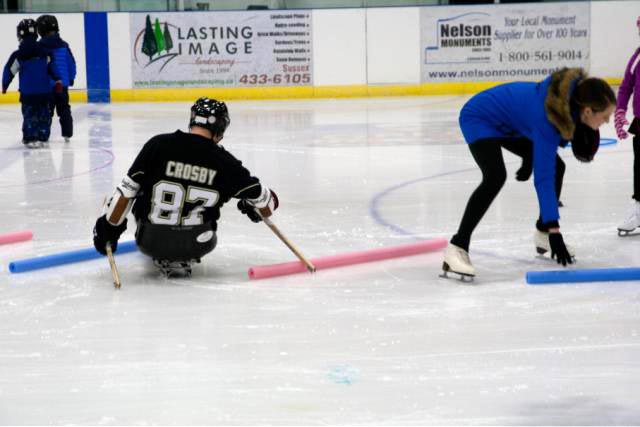
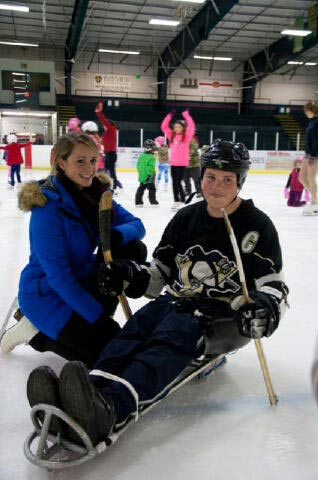
Noah Robichaud

A commercial Tammy Robichaud says changed Noah’s life. Going through yet another round of rehabilitation following surgery this past summer, Noah was watching TV when he saw a Gatorade commercial featuring Crosby playing sledge hockey with several disabled athletes.

The dream was born. Noah formed the steel resolve that he was going to be just like Crosby, his childhood hero. So ironclad was that resolve that when Noah left the Stan Cassidy Centre for Rehabilitation in nearby Fredericton, a sledge, loaned from Para New Brunswick, made the trip home with him.

Through social media, Tammy Robichaud reached out to the Sussex Skating Club, a mere ten minutes from their home in Penobsquis N.B., to inquire about a skating program for special needs children. Club officials worked with Skate Canada, and planning began. Coach Kirsten Graham, herself a CanSkate graduate from the club, trained with Para New Brunswick to help her prepare.

Weeks after bringing that sledge home, on October 7th, Noah took his first CanSkate lesson.

“When he falls over, he finds it hilarious and he just keeps laughing,” says Stacey Rouse-Charlton, head coach at Sussex Skating Club. “You can see every little bit of achievement from lesson to lesson.”

“Oh, yes, he’s not falling over nearly as much,” laughs Tammy Robichaud when asked if she sees her son progressing after his first couple of weeks on the ice.

“This has been life changing not only for Noah, but for a lot of us at the club, as well,” adds Rouse-Charlton. “I have never seen a child so happy. That smile widens with each lesson. We are a pretty small club, so to be able to work with a child like this is extremely gratifying. He is a very special young man.”

Noah RobichaudSporting his Crosby jersey, Noah takes to the ice twice a week to work with Graham. Sitting in the stands, Tammy Robichaud cheers her son on as he makes his way around the modified CanSkate circuits, a mother sharing a cloud with her son as they live a dream.

Their dream.

“I hope this shows that just because a child has a disability, doesn’t mean they should be held back,” adds Tammy Robichaud. “Every child can do whatever they want, be whoever they want.”

“Noah’s story is one of inspiration and perseverance, and a testament to the true strength of the human spirit,” says Skate Canada CEO Dan Thompson. “Skate Canada is committed to continue to find ways of providing inclusive initiatives allowing all Canadians to embrace the joy of skating.”

“As a mom, nothing else matters but seeing him happy,” says Tammy. “He is a kid learning to skate, like everyone else.”

Rouse-Charlton says the largest hurdle the club has faced with Noah was finding a convenient way of getting him on and off the ice. A local contractor, whose daughter is taking CanSkate at the club, built a custom-made ramp for the club.

Word is starting to spread. The little club in New Brunswick has received several calls about the program and soon, one of Noah’s young friends will start lessons, once doctors and physiotherapists have given their stamp of approval.

“That is a special kid right there,” says Rouse-Charlton of Noah. “He’s not sitting on the sidelines saying ‘look at me, I have cerebral palsy.’

“He’s saying ‘look at me, I have cerebral palsy and can skate.’”

Skate Canada International Primer, Part I

SCI 101

What, exactly, is Skate Canada International?

Skate Canada International is the second stop in the International Skating Union (ISU) Grand Prix of Figure Skating Series. The series also includes events in China, France, Russia, Japan and the U.S. During the series, points are awarded in the four disciplines (men’s, ladies, ice dance and pair) based on event results.

The Grand Prix Series culminates in December 2015, when the top six Series finishers in each discipline square off in the ISU Grand Prix of Figure Skating Final in Barcelona, Spain.

Nearing the halfway point between the 2014 and 2018 Olympic Winter Games, the 2015 edition of SCI also will allow fans a sneak peek at potential Olympic contenders for the 2018 Games in PyeongChang, South Korea.

TICKETS

Get your tickets today to witness this world-class international showdown in Lethbridge. Visit enmaxcentre.ca or call 403-329-7328.

TV SCHEDULE

SCI will be broadcast in Canada by TSN, CTV and RDS, the event’s official broadcast partners.

A podium worthy volunteer career

For super volunteer Fran McLellan, her interest in community activities began in her hometown of Ingersoll, Ontario, with parents who were strong role models when it came to offering their time to help.

Volunteering was definitely a community and family priority.

Fran remembers being inspired by the Director of the local YMCA, Al Clark. “He encouraged me to form ‘Teen Town’ and organize Friday Night Dances at the Y. He also helped me to swim competitively and hired me to teach and lifeguard at our local pool.”

That experience and others set the stage for Fran’s love of sports. “We swam in the summer and skated in the winter,” says Fran. “Along with my older brother and two younger sisters, we started skating at a very young age. My brother played hockey and the girls took figure skating lessons. I remember our mother driving us to early morning ‘patch’ lessons and then getting us to school on time.”

Many of her fondest memories revolve around skating in the club Ice Shows and wearing the wonderful costumes. “Some of the costumes were rented from the Unionville Skating Club. I also remember one year when our coach, Liliane de Kresz, skated a solo to the music Sabre Dance. I’ve never forgotten how fast she could skate!”

Growing up, Fran was dedicated to advancing her own skating skills, eventually earning her silver medal in dance. Once married, she and her husband John moved to Oakville where the Oakville Skating Club was a major star in the community. Fran thinks back, “Coming to Oakville, one of my first recollections was the parade welcoming home Maria and Otto Jelinek from the 1962 World Championships in Prague with their gold medal in pairs figure skating.”

That event sparked her interest in the Oakville Skating Club.

“One day I got brave enough to walk into the Club to see about registering our children for lessons and was pleasantly surprised at how easy it was to sign up. Louis and Marijane Stong were their first coaches – group lessons – three times a week.”

While Fran continued to skate herself and take on new volunteer club responsibilities at the same time, her children were following in her skating footsteps, Michael in hockey and the girls in figure skating. During this time, Fran was also discovering another side to the sport, precision skating, now called Synchronized Skating.

It was at an ACGM where she attended a precision workshop and listened to advocate Elizabeth Swan. “She was so keen to talk about this new discipline that everyone in the room became excited about taking the information back to their clubs.”

Realizing that not every figure skater could become a Barbara Ann Scott, Fran liked the team element. “There were very few team sports for girls when I was growing up,” admits Fran. “Finally, with precision, the girls and I had something we could do together!”

Fran remembers the beginning of the sport. “At first the teams were very large, 24 to 32 skaters, so it meant a lot of individuals found a new home at the rink. The skaters could set new goals, travel as a team to overnight competitions and share in the expenses.”

Fran was so attracted to precision, she continued to skate competitively for 25 years on adult teams and even sometimes on teams with her daughters. Yes, both Laura and Leanne caught the precision bug too, skating on teams in Oakville and in Burlington all while pursuing more traditional skating honors, Laura eventually earning her gold medal in Figures, Free Skate and Dance and Leanne earning her gold medal in Dance.

“Laura started judging when she was sixteen and is qualified to judge all disciplines – singles, pairs, dance and synchro,” boasts Fran. “At the age of 9 Leanne was an alternate on the senior team in Oakville and continued to participate in the sport until she retired at the age of 34.”

Fran recalls her proudest moment as a synchro skater. “It was at Synchro Nationals in 1994 in Verdun, Quebec and our Oakville adult team, skating to Pomp and Circumstance, earned a bronze medal.  I believe that was the first time a mother and two daughters skated together and won a national medal.”
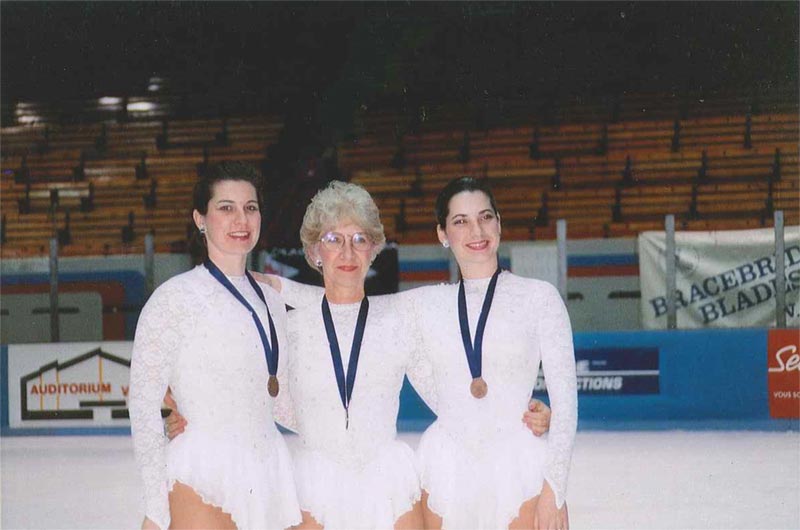
Fran McLellan

1994 Adult Nationals – Fran McLellan

Once Fran hung up her skates, her transition to becoming a full-time volunteer was completely natural. Although she’s tiny in stature, her infectious spirit and endless enthusiasm meant she could take on jobs and get things done.

“Somehow it just happens. One day you’re driving your kids to the rink and the next thing you know you’re attending planning meetings and voting on budgets.”

Skating wasn’t the only activity on Fran’s list of priorities. “I volunteered at our high school, church and the YMCA, helped out with all the activities at school, volunteered at our hospital and the IODE, sat on several town committees and was a founding member of the Oakville Sports Hall of Fame.”

But it was when she was appointed Accreditation Director for the Winter Special Olympics that Fran found one of her most challenging and rewarding experiences.

“My committee accredited over 10,000 participants, officials, managers, chaperones, entertainers, food vendors, directors and special guests. It was a year-long process working closely with the Kodak people to develop the photo ID system. The experience and the people we met along the way were priceless.”

Back in the rink, Fran devoted countless hours volunteering at local, regional, provincial, national and international skating competitions. “At most of the synchro competitions I was judging, skating and managing. Always a challenge for the Tech Rep,” Fran laughs. “I had to make sure I removed the headset before going back on the panel!”

Today as Business Manager for Canada’s World Champions, NEXXICE, Fran is looking forward to the sport’s acceptance into Olympic competition. “My prediction is 2022 in Beijing, China.  And now this year for the first time Synchro will be part of the Grand Prix Final in Barcelona. As the old saying goes, we’ve come a long way baby!”

For her vision and commitment, Fran has been recognized by both Oakville and her skating community. She was inducted into the Oakville Sports Hall of Fame this year and has been the recipient of the Elizabeth Swan Memorial Award for her contributions to synchro skating. While delighted with these honors, Fran’s proudest moment came after the 2013 World Synchro Championships in Boston when NEXXICE presented her with the Team Spirit Award.
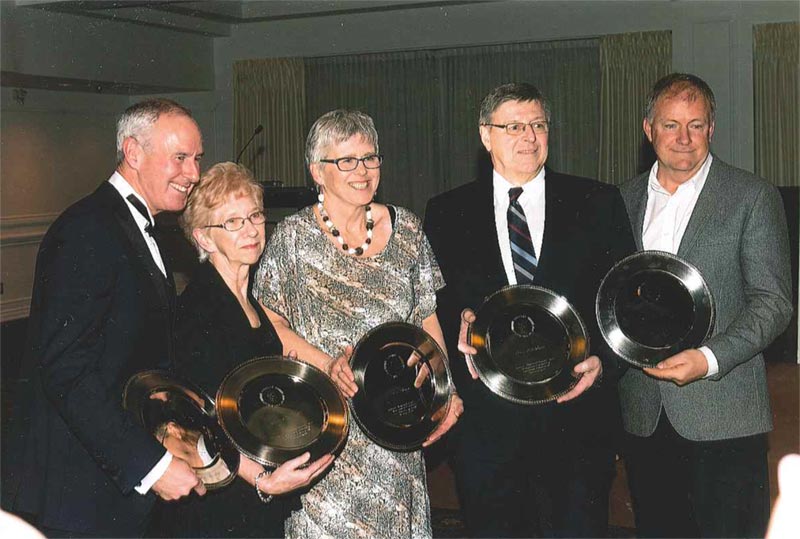
oakville-sports-hall-of-fame-induction

Oakville Sports Hall of Fame Induction

Over the years Fran’s name has become synonymous with volunteering. “I’ve learned that it takes a ‘team’ effort to make things happen. I’ve gained a lot of friends – young and old.”

For Fran, volunteering has worked two ways. While she’s given her time and dedication, volunteering has given her a lot in return. “It’s kept me grounded,” says Fran.

Her advice? “Get involved and stay involved. One day you’ll be glad you did and the memories will live with you forever.”

Conrad Orzel overcomes injury, ready to face a new season of challenges

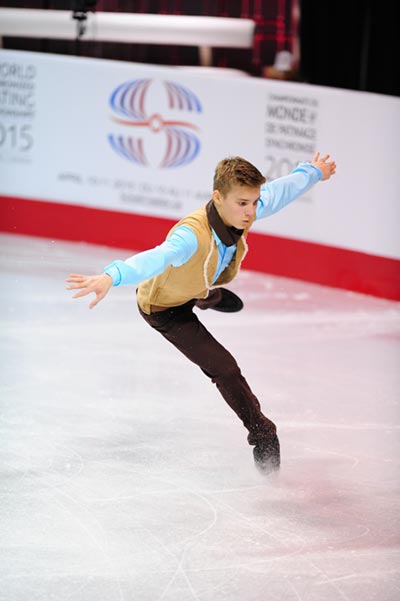
Conrad Orzel, wrapped in a sheepskin vest, took his opening pose at the novice contest of the Canadian Tire National Skating Championships and quickly began to rumble.

The program? “The Good, The Bad and The Ugly,” a 1966 spaghetti western in which a trio of gunslingers go on the prowl to find buried gold.

Orzel didn’t find the gold that January day in Kingston, Ont., (he won the bronze medal), but his effort was a triumph nonetheless. It was a testament to his grit that he was there at all. For a skater so young, he learned a big life lesson last season.

Orzel, of Woodbridge, ON, was as ready as he could be heading to Challenge the previous month but just before the event, suffered a torn ligament in his left leg and also an avulsion fracture, in which a piece of bone chips away from the main part of the bone as a result of a fall, or a muscular contraction that is stronger than the forces holding the bone together.

The young skater had no idea just what was wrong at the time. He just knew it was very painful. Coach Eva Najarro found out about it the day before they were to leave for Challenge. Then during a morning practice, Orzel approached her, close to tears, and said he just could not spin on his left foot.

This was just not like Orzel. He wouldn’t jump at those practices, either. And he loves to jump, more than anything. “It was like he wasn’t there,” Najarro said. “I know that he loves practices, because he likes to show off. He wants to show what he can do. I knew there was really something wrong with him. He was just skating around.”  Massage didn’t help. She gave him the option of withdrawing.

Spins were not always Orzel’s forte, but they were improving. But he took on an extra challenge by having Najarro recreate all of his spins to take the pressure off the left leg. “He was not able to do the spiral on the left foot, so we had to change it totally to a backwards entry to the spin,” she said. “We revamped, basically on the practice at Challenge.”

In other words, Najarro had to change his spins from forward to backward entries.  Najarro’s skating daughter, Alexandra, who knows all about dealing with injury, had a chat with Orzel, and bucked him up psychologically.

When Orzel got off the ice, he had qualified for nationals. The tears came, Najarro, too. “It was just so emotional,” she said. “We were both pretty stressed about it, because it was really hard to watch him.’

“I just wanted to try my best,” he said. “That was my goal for nationals, nothing more.”

He took four weeks off after that event. Immediately upon returning home, a doctor told him that he didn’t know how he had skated at all. He was still not fully healed when he went to nationals in Kingston.

Another problem surfaced too. Orzel was sprouting like a weed, and he outgrew his boots. He had to also try to break in a new pair before Kingston. “I just wanted to try my best,” he said. “That was my goal for nationals, nothing more.”

His good, bad and ugly was all that and more. He landed seven triples. “I was very proud of what I did,” he said.

Currently, Orzel is fine. He has healed. There is no more pain. And now he’s trying to create the next chapter of his career. He did win a gold medal for novice men at the Canada Winter Games. But now he’s pushing on.

He knows what he wants. When he was three, he started in CanSkate at a local club and Najarro spotted him. What was most remarkable about the young boy in front of her was that he wanted to skate. “The thing that caught my attention was that here was a 5-year-old boy who already knows what he wants to do,” she said. “That’s rare.”

Conrad OrzelOrzel said he became interested in skating because that’s what Canadians do. “I think I was thinking of growing up to be a hockey player,” he said. “ But then once I saw the high-end skaters jumping and that really got me into it.”

His heroes are Elvis Stojko and Evgeny Plushenko.

“He always liked to turn,” Najarro said about Orzel. “He has very quick twitch. Rotation is easy for him.”

Because Orzel has always focused so much on jumps, Najarro has been trying to turn his attention to the other side of skating: edges, details, flexibility, that second mark. And he gets it. (After all, he trains every day alongside the exquisite Roman Sadovsky at the York Region Skating Academy.) Orzel has improved already and his goals for the coming season are getting level-four spins, and level three or four footwork. “When I started, I wasn’t really a big fan because my core wasn’t strong,” Orzel said. “But now I’m getting deep into the edges and I realize that it is fun.” He also wants to get a triple Axel into his programs.

For the past year, Orzel has been training the triple Axel – and both the quadruple toe loop and quadruple Salchow jumps. The triple Axel isn’t consistent yet. “I’ve landed a few but it’s not there yet,” he said. He says he tries the quads without harness.

“I’m not a fan of the harness,” he said. “I feel like it’s an artificial feeling and I don’t feel in control of my jumps.” Soon, he’s heading off to Vancouver to work with Joanne McLeod on his quads.

Another remarkable thing about Orzel. He’s only 14.

While Grzegorz Filipowski has designed many of Orzel’s programs – Najarro likes his work very much – she is taking her young charge to Allison Purkiss this year to give him the experience of working with another choreographer.

“I think he has potential,” Najarro said. “I think his jumping abilities are amazing. I think he has a bright future.”

Our coaches are the champions this week!

Skating coach finds lost skating keepsakes after 25-year mystery

Photo albums are documents of life.

For ice dancer Bryon Topping, 1965 world team member with Lynn Matthews, they tell the skating story of a young man from Swift Current, Saskatchewan, his interests and his accomplishments. Sadly, some 25 years ago, his albums disappeared.

“After my mother passed away I went home for the burial and while I was there I packed up a couple of boxes of memorabilia and sent them back home to Ottawa on the bus. One of them made it, however the other one did not.”

It had vanished … along with irreplaceable photos documenting the successful skating career of an individual whose skating-for-life philosophy was neither planned for nor anticipated.

“I broke my leg when I was in grade 3 and spent over eight months in casts,” recalls Bryon. “I was told that I couldn’t participate in contact sports, that if I suffered another break, I could lose my leg.”

Living in rural Saskatchewan, there were few options for rehabilitation so his family decided to enroll him in skating at the Swift Current Skating Club.

“For me, skating began as therapy,” admits Bryon.Young Bryan Topping

Turns out not only did he get the rehab exercise he needed, Bryon also discovered a fascination with the sport and quickly passed his Preliminary tests. Although his family wanted to continue to feed their son’s unexpected interest and ability, they knew there were some tough decisions ahead if Bryon was to choose a competitive path. With no artificial ice available in Swift Current at the time, their eyes turned 150 miles eastward toward Regina and the Wascana Winter Club.

Bryon’s dad, Bert, worked for the railroad which entitled Bryon to a travel pass. “Every Saturday morning I’d get up at 4:30 am, catch the train at 5:30 and be in Regina by 9 to skate for the weekend and then return home Sunday night.”

Bryon also remembers his first competition in Regina in the mid ‘50’s. “It was a Bronze Dance event skating with my first partner Sandra Mitchell. Competing and watching veterans like Alma English and Herb Larson, then President of the C.F.S.A. (1953-55), was a great experience. After that I was hooked!”

Although Bryon’s passion for skating was growing, he was also learning other lessons that were not as positive. “At the time, a small city in Saskatchewan was not a place for a male figure skater. I was picked on, bullied and beaten up.  At school, I even had a teacher who I asked for extra help so I could go to a competition. He refused.”

Despite the challenges, Bryon’s motivation flourished. He studied skating, dreamt about the possibilities and watched the best athletes, deciding that one day he would be one of them. With the support of his mom and dad and his grandparents, his training increased. He travelled across the country to seek out high level instruction until finally landing in Toronto with Coach Dick Rimmer.

“That’s when I was partnered with Lynn,” recalls Bryon.

The dance team clicked and as Bryon’s lost photo albums would have shown, the pair spent several successful years on the competitive circuit culminating in an 11th place finish at the 1965 World Championships. After the partnership dissolved, Bryon decided to turn pro to teach back in Regina.

He soon learned that his teaching style didn’t fit every situation. “I had to adapt!” he says. “Thankfully one of my best talents was having a quick eye which helped me see the nature of mistakes and then work on correcting them.”

And correct them he did, counting many students’ successes in Saskatchewan and then again in Ontario when he moved to Stratford and began to broaden his skating experience.

“It was in Stratford that I was asked to help with Power Skating.”

As an avid hockey fan, Bryon had often observed that most hockey players didn’t know the basics and had no idea how to use the blade, balance points, and body position. As a result, he started to design hockey exercises that would develop fundamental skating skills. It caught on … fast!

He also remembers how the players taking his class would snicker when he came on the ice in his figure skates. “After giving them a few minutes to warm up, I’d blow the whistle and order them to take a knee.” He’d then tell them to look at his feet. “This is what I wear so get over it!”

His classes began with basic exercises on quick starts, teaching balance, what part of the blade to be on and what to do with their toes, among other important techniques. “It wasn’t long before they realized I wasn’t going to teach them triple Lutzes. What I was going to teach them was how to be better skaters.”

After relocating to Ottawa, Bryon moved to the Gloucester Skating Club and continued to refine his coaching philosophy to make every skater better.

“I was approached by a hockey player who had a try-out with the Toronto Maple Leafs and asked if I’d work with him. I agreed but quickly realized there wasn’t a lot I could do in just one practice.”

The next year the player came back. “I told him that if he wanted my help he would have to take my 3-week summer class. Most of that class had good Jr. A players in it and he would have to work his buns off to keep up … he agreed. At the end of 3 weeks he was a different skater. He had learned how to turn in both directions with power, stop on all edges, skate backwards with power; all the important moves. He went to the Leafs try-out camp and because of his hard work had many successful pro years in the NHL.”

That experience … and others like it … gave Bryon a great deal of satisfaction. “It was the same when I was the Power Skating Coach for the Cornwall Colts Jr. A team for three years. It was always nice to hear them call me ‘Coach’.”

Although he continued coaching Power Skating till about 10 years ago, these days his time at the rink is spent watching his grandson play hockey. “My knees were giving out on me so I hung up my skates.”

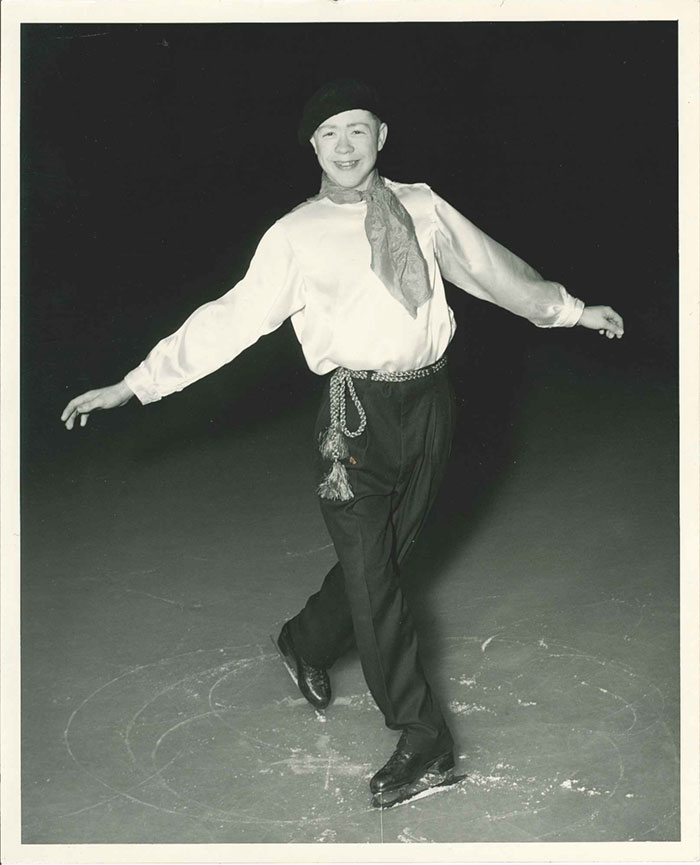
Bryon Topping

Still … after a lifetime of immersion in every aspect of skating, Bryon was still puzzled by the 25-year mystery of the missing photo albums. Then one day his Facebook page suddenly lit up with details of a recent story in the local Swift Current paper, the Prairie Reporter, telling about a gentleman, Leon Echert, who had bought a box of memorabilia and photographs at a garage sale. Realizing they might be important, he began looking for their owner.

“I am very grateful to Mr. Eckert for finding them and returning them to me,” says Bryon. “And thanks to my friends on Facebook for connecting us. The pictures of Lynn and I are very special, the only ones taken before we left for Worlds.”

Finally … at least some of the mystery has been solved.

Bryon smiles as he adds, “I have a Canadian Emblem that I wear with pride. I’m also proud of the fact that I was a member of the first skating team to represent Canada under the new Canadian Flag.”

And now he has the photographs to prove it!

Pettitt Makes Leap to Junior With Hopes of Continuing Gold Rush

Whitehorse, Yukon is known as the least polluted city in the world, and also the driest in Canada. It was the birthplace of Pierre Berton, federal NDP leader Audrey McLaughlin, and Yukon bard Robert Service.

It is also the home of Rachel Pettitt, the first Yukon born athlete to win a national skating title. She won a gold medal in the novice women’s category at the Canadian Tire National Skating Championships in Kingston, ON, in January.

In a town of 25,000 (largest in Northern Canada), with three ball diamonds, a Canada Games multiplex (with pools, ice rinks, a fieldhouse, and a fitness centre,) three golf courses and a bowling alley, it was the Arctic Edge Skating Club where Pettitt’s mother, Trish, caught the skating bug first.

Rachel’s three older brothers started out in CanSkate, with Trish coaching it. “My family was all on the ice, so they got to put me on and see how it goes,” Rachel said. “And then I loved it. I loved spinning and jumping.”

While Trish may have hoped her sons would become figure skaters, they turned into hockey players. After all, father Kerry is a hockey coach when he’s not working for Northwestel, a telecommunications company serving the north.

Trish was born in Whitehorse, skated with her sisters, and then went off to Vancouver for a while to hone those skills. Now she’s a coach. And Rachel has followed in her footsteps by moving to Kelowna B.C., where she works with coaches Karen and Jason Mongrain.

In Whitehorse, Rachel learned all the fundamentals. She achieved all her gold tests there for skills, interpretive, and free skate. The dancing skills that she learned in Whitehorse also really helped. “I always did off-ice dance, off-ice ballet,” she said.

“I loved training in Whitehorse,” said Rachel. “But now that I’m older, I needed to move on, and get some real training in.” That meant, at first, Calgary, which she came to love. There she worked with Scott Davis and the late Sharon Lariviere. “She was amazing,” Rachel said. “I give a lot of credit to her. My mom got coached by her too and a lot of my cousins. I learned the basics from her. I learned a lot about posture, a lot about your lines. I learned a lot of jumps, spinning. She did everything for me.”

By the time she was 11, Rachel had moved to Kelowna, and it was scary at first, she said, living by herself, boarding with a family. When she was in grade eight, she returned to Whitehorse, because it was difficult to be away from her family. “I struggled,” she said.

As a grade nine student, she returned to Kelowna. Sometimes her parents would visit, but it takes two full days of driving to travel between the two cities.

“She was always a very bubbly kid,” said Jason Mongrain. “She had a lot of personality. She had a lot of intensity on her presentation side. And she was coordinated in terms of her jumps. She was always a very good spinner too.”

From the Mongrains, Rachel has learned three triples: toe loop, Salchow and loop. Now the push will be on to teach Rachel the triple flip and Lutz. “There’s definitely a lot of work that still needs to go into those jumps…. There’s a lot of fine-tuning, drills and exercises she has to do to become automatic at it.”

Still, she’s buoyed by the memories of last season, when she won the national novice gold medal. She had been third after the short program, and for the long, she skated to Lara’s Theme from Doctor Zhivago, floating about in a white dress with white illusion sleeves and white fur about her neck. It was a triumph just getting to that event. The previous year she hadn’t even qualified for Challenge. This past season, she finished second at Challenge.

“I was thrilled going to Canadians,” she said. “I felt a little bit of pressure on myself…But by the time the long came, I was like: “I’m just going to go out and skate my best. Whatever happens, happens. It was amazing.” She was overwhelmed with the marks she got. “I just knew I gave it my all, and whether I got a medal or not, I was pleased with how I skated,” she said.

This earned her a berth at the Canada Winter Games in Prince George, B.C., where she also won a gold medal. “That was such an amazing experience,” she said. “I got to share it with a lot of Kelowna skaters. It was so much fun. Jason and my mom were the coaches for Team Yukon and I was representing Team Yukon.”

She knew it was her last skate in that white dress, and vowed she’d go and skate the way she could again, a clean program ensued. She doesn’t think she’ll ever be able to get rid of that white dress. “I have so many good memories with it,” she said.

Jason says the Canada Winter Games were a big step for Rachel, because although she had a great performance on a national stage in Kingston, the “Canada Games was a different animal.”

“There was almost more pressure on her at Canada Games because of the results she got at Canadians,” he said. “So she went into that competition as a clear favourite. She definitely wasn’t a clear favourite at Canadians. She was one of a handful of skaters that had the opportunity and ability to win, and she was a skater that laid down what she had to do to win that day.”

She’ll compete at the junior level this coming season, and aside from gaining triples, the Mongrains are helping her increase her program components. She’s strong in that area, but Jason says they want to exploit her strengths. “We have to find new ways of challenging her so she has two new programs which are very demanding,” he said.

Karen has choreographed the short, Jason the long. There will be more intricate steps, and there’s not a lot of rest time. There will be less setup time for her triples and her double Axel.

“We’re trying to achieve a more senior level of skating even though she’s moving into junior,” Jason said. It’s all a sign that good skaters can come from anywhere.