
Pride Profile: “It makes you wonder if there is something wrong with you”
June is Pride Month and an opportunity to highlight and celebrate the LGBTQI2S+ community. Skate Canada has done and is continuing to do substantive work in relation to LGBTQI2S+ inclusion but we know there remains critical inclusion work to be done moving forward in relation to race, ethnicity, Indigeneity, religion, class, size, and ability, and their intersections.
To support an inclusive environment this Pride Month we are sharing personal stories from our skating community. Below is the story of Dr. William Bridel.
 I began skating when I was four years old. The goal at the time was to learn basic skills so I could go on to play hockey when I was older. Playing hockey never happened. I fell in love with movement and music that skating offered and had, before I knew how to stop, taught myself how to jump and spin…and shake my booty to, well, Shake Your Booty.
Growing up as a male figure skater in the 1970s was pretty lousy. The 1980s weren’t much better. Neither were the ‘90s to be honest. I know I’m not the only male skater who got bullied and I also know that boys across the country continue to face ridicule because of their involvement in the sport. But when you’re gay and you experience being called “queer”, “f**got”, and “sissy” on a daily basis because you figure skate, it cuts deep. It’s not something you can easily shrug off because people are wrong in the assumptions they make about you because you—gasp—don’t play hockey. When you know that you’re gay or queer and you’re being called all those names, when you’re being pushed and shoved and kicked and worse, it sits with you. It festers. It makes you wonder if there is something wrong with you. Because, after all, these are clearly terrible things that you are being called. No one should want to be any of those things. But, you know you are. And when there is silence in the sport that you love, when no one talks about the fact that there are other gay skaters, when you don’t have any role models to look up to…it’s torturous. That’s what I grew up knowing. That’s what I grew up experiencing. And it was really, really shitty.
But I loved skating. I still do. I’ve been involved in the sport in many different ways from my shaky beginnings at the Aurora Skating Club (I say shaky because of the aforementioned booty shaking, but also because I managed to fail in my first attempt at the Beginners badge: insert face palm here). Since that time, I competed at a few national championships and one international event, passed four Gold tests, judged, evaluated, volunteered, worked at the national office, and have been doing various research-related projects with Skate Canada over the past several years. I’ve (almost) always been a fan of the sport as well. There were definitely times over the years when being passionate about the sport wasn’t the easiest; but there are also many, many good memories. This is one of them.
My last year of competition was the 1992-93 season. By this point in my career I had competed in singles and pairs, but in the summer of 1991, I tried to re-invent myself as an ice dancer. My partner in my final season was Kristin Borger, and we represented Manitoba. We narrowly missed qualifying for the national championships, finishing fifth at Divisionals (remember when?!). Kristin was an incredible partner because she had such “joie de vivre”; training was fun, competitions were fun, socializing was fun. I was by this point in time, completely open about my sexuality with friends, family, and with coaches and skaters with whom I trained, a slow and careful process that had begun four years earlier.
But there still remained a tremendous silence in skating about sexuality, and even more silence around the many amazingly talented young men in our sport who were dying of AIDS-related causes. That is until Tracy Wilson and Brian Orser, and many others from the skating family, organized an ice show called Skate The Dream, a fund- and awareness-raising event held in memory of the great Rob McCall, who had passed away in 1991. I remember attending the show at Varsity Arena in Toronto with my mom and a couple of friends. It was an incredible evening and I was in awe of the skaters who were involved. I remember thinking that night that maybe the silence had been lifted. But that was, in hindsight, only temporary.
So, where do ice dancing and Kristin fit into all of this? In May 1993, Kristin and I were invited to participate in the Manitoba Bursary Show, held at the Winnipeg Winter Club. I had an idea and broached it with Kristin. Without missing a beat, she agreed. See, Kristin is what we would now refer to as an “ally”; that term didn’t necessarily exist back in those days, at least not in the way we use it today. An ally to the LGBTQI2S+ community not only loves and supports LGBTQI2S+ persons in their lives but takes action to make strides toward equity, speaks out against social injustices, and makes public their support of their queer friends and family. That was Kristin all the way back in 1993. My idea? I wanted Kristin and I to perform to a song that Elton John had released in 1992 called The Last Song. John’s lyrics tell the tale of a father making amends with his estranged son, who is gay and dying of AIDS-related illness. We wore all black and donned red ribbons, a symbol of solidarity for people living with HIV/AIDS. It likely was all a bit too subtle, but at the time it felt like a way to make a statement from a personal place about the grief and sense of loss I was experiencing and the helplessness I felt. Kristin supported this idea and we choreographed the piece together; she never questioned why it was important to me. She just knew. I don’t know that I ever properly thanked her or let her know how essential that moment was for me in my life. It turned out to be my last “amateur” performance and it remains with me today as one of my proudest memories in the sport.
I often find myself wondering what amazing contributions those young men that we lost to AIDS would have made to our sport and to our world. I hope that some of you do as well; they deserve that.
And Kristin, to you, a long overdue but emphatic “thank you”!
Skate Canada thanks to Dr. William Bridel for sharing their story and bringing awareness to the skating community. If you are a member of the LGBTQI2S+ skating community and are interested in sharing your personal story please send us an email at [email protected].
 I started out in skating after watching the 1988 Olympics and insisting to my mother that I wanted to ‘fancy skate’. Being the supportive and encouraging parents they are, my parents put me in recreational lessons then into CanSkate, where I quickly fell in love with our sport.
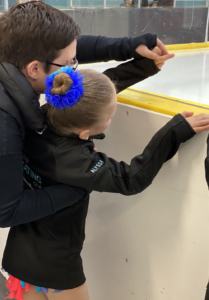 I was in eleventh grade before I came out to myself and began coming out to others. After witnessing other friends experience rejection from their adult mentors, teachers and coaches I wasn’t sure I could survive it if it happened to me and couldn’t risk it with mine. This comes across as dramatic, but in truth was probably pretty spot on. I made the decision to change coaches to a younger, less experienced coach in order to not feel any possible negative (or perceived negative) reaction as acutely. To avoid any disappointment in myself as a person from people whose respect I couldn’t stand to lose. In effect, and to my own skating’s detriment, at the end of my personal skating career, I abandoned them before they could me. To be clear, I didn’t have an inkling of how they’d react. I just couldn’t muster up the courage to risk them finding out. I remember my female coach hiding her tears and thinking that at least she was disappointed in me for something I chose rather than something I couldn’t. I remember the last hug from both of them and running out of the arena sobbing hysterically – I knew I’d made a huge mistake but I wasn’t willing to rethink my decision because it was still easier than the alternative that might never and probably wouldn’t have happened anyway. Both of them left our club very suddenly immediately afterwards, moving full time to the other club they taught at. They had been staying until I graduated and moved on; I was their ‘last’ at our club. When I left them, they left, too.